Every year on 2 October, India pauses to remember the man who led a nation to freedom without raising a weapon. In 2026, Gandhi Jayanti marks the 157th birth anniversary of Mahatma Gandhi. Schools, colleges, offices and communities are preparing speeches, essays and tributes for the day. This guide gives you ready-to-use Gandhi Jayanti speeches in English, essays from 10 lines to 500 words, and the most meaningful Mahatma Gandhi quotes. It also covers the history of the day and how Gandhi's ideas apply today. Written by the content team at AMICI Global Solutions, a digital marketing agency in Dwarka, Delhi, it is built to be accurate and easy to use.
Quick Answer: Gandhi Jayanti 2026 is on Friday, 2 October 2026. It marks the 157th birth anniversary of Mahatma Gandhi, who was born on 2 October 1869 in Porbandar, Gujarat. It is a national holiday in India and is observed worldwide as the International Day of Non-Violence, established by UN General Assembly resolution A/RES/61/271.
Why Is Gandhi Jayanti Celebrated on 2 October?
Gandhi Jayanti is celebrated on 2 October because it is the birthday of Mahatma Gandhi, the leader of India's non-violent freedom movement. India honours him as the "Father of the Nation". The date is also marked worldwide as a day devoted to peace. The occasion celebrates his principles of truth (satya), non-violence (ahimsa) and self-reliance (swaraj).
History and Significance of Gandhi Jayanti
From Porbandar to a global movement
Gandhi trained as a barrister in London and went to South Africa in 1893. There he faced racial discrimination and developed Satyagraha, a method of resisting injustice through truth and non-cooperation rather than violence. After returning to India in 1915, he led several landmark movements:
-
Champaran (1917): Support for indigo farmers facing exploitation.
-
Non-Cooperation Movement (1920–22): Mass withdrawal from colonial institutions.
-
Dandi Salt March (1930): A march of roughly 240 miles to challenge the colonial salt tax.
-
Quit India Movement (1942): A call for the end of British rule.
India became independent on 15 August 1947. Gandhi was assassinated on 30 January 1948.
The United Nations connection
The UN General Assembly established the International Day of Non-Violence through resolution A/RES/61/271 in June 2007. It is an occasion to spread the message of non-violence through education and public awareness. The resolution was cosponsored by 140 countries, and the UN notes that Gandhian values have inspired movements led by figures such as Martin Luther King Jr. and Nelson Mandela.
Gandhi Jayanti 2026: what's happening this year?
India's youth platform MY Bharat is organising nationwide initiatives on Gandhi Jayanti 2026, including cleanliness drives under Swachh Bharat, tree plantation, digital literacy programmes and rural upliftment projects. One report found no single official nationwide theme for 2026 in the sources it reviewed. Speakers can therefore choose their own, such as non-violence in the digital age, self-reliance or service and cleanliness.
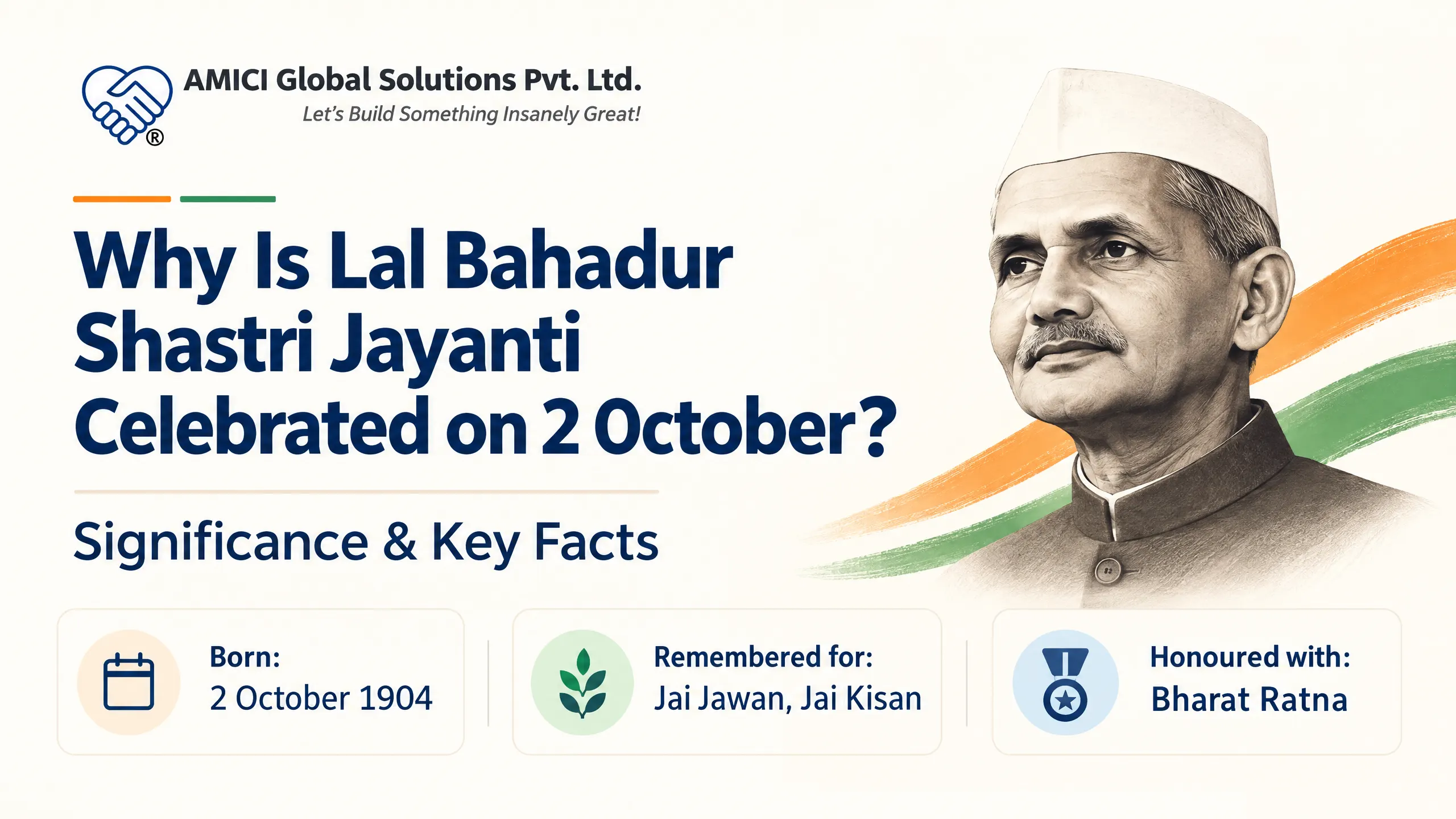
2 October is also the birthday of Lal Bahadur Shastri, India's second Prime Minister, known for the slogan "Jai Jawan Jai Kisan". A line about him adds depth to any speech.
Gandhi Jayanti Speech in English (Ready to Use)
1-Minute Speech (Morning Assembly)
Good morning to our respected principal, teachers and dear friends.
Today, 2 October 2026, we celebrate the 157th birth anniversary of Mahatma Gandhi. Born in Porbandar in 1869, he showed the world that a nation can win freedom without violence.
Gandhi ji taught us three simple lessons: speak the truth, respect every human being, and be self-reliant. These lessons matter in classrooms, homes and online spaces just as much as they mattered during the freedom struggle.
Let us promise today to keep our surroundings clean, treat everyone with kindness, and settle disagreements without anger.
Thank you. Jai Hind!
3-Minute Speech (Schools, Colleges, Offices)
Respected chief guest, esteemed faculty and my dear friends,
We gather today to remember a man who never ruled a country or commanded an army, yet changed the course of history. Mahatma Gandhi was born on 2 October 1869. On his 157th birth anniversary, we remember him not as a statue or a face on a banknote, but as a living idea.
That idea was Satyagraha, the force of truth. When Gandhi ji walked to Dandi in 1930 to make salt, he was not just breaking a law. He showed ordinary Indians that they had power, and that it could be used without hatred.
Why does this matter in 2026? Because we live in a time of loud arguments, online trolling and quick judgements. His reminder that the means matter as much as the ends is more relevant than ever.
He also taught the dignity of labour. He spun yarn on the charkha to show that no work is small. Today we call that self-reliance, the spirit behind local entrepreneurship and Atmanirbhar Bharat.
The United Nations also honours this day as the International Day of Non-Violence, so his message belongs to the whole world.
So let us do three things. Tell the truth even when it is uncomfortable. Choose dialogue over anger. Serve someone in need this week. That is the finest tribute we can offer.
Thank you. Jai Hind!
Gandhi Jayanti Essay (Ready to Use)
10 Lines on Gandhi Jayanti
-
Gandhi Jayanti is celebrated every year on 2 October.
-
In 2026, it marks Mahatma Gandhi's 157th birth anniversary.
-
Gandhi ji was born in Porbandar, Gujarat, in 1869.
-
He is called the Father of the Nation.
-
He led India's freedom movement through truth and non-violence.
-
Famous movements include Non-Cooperation, the Dandi March and Quit India.
-
Gandhi Jayanti is a national holiday in India.
-
The UN observes 2 October as the International Day of Non-Violence.
-
People celebrate with prayers at Raj Ghat, cleanliness drives and school programmes.
-
The day reminds us to live by honesty, peace and service.
Short Essay (150 Words)
Gandhi Jayanti is celebrated on 2 October to honour Mahatma Gandhi, who was born in 1869 in Porbandar, Gujarat. He led India's freedom struggle using truth and non-violence instead of weapons. His movements, including the Salt March and Quit India, awakened millions of Indians. Gandhi ji also promoted cleanliness, equality and self-reliance through the charkha and khadi. The day is a national holiday in India, and the United Nations also observes it as the International Day of Non-Violence. On this day, people pay tribute at Raj Ghat, sing his favourite bhajans and join community cleaning programmes. The 157th anniversary in 2026 reminds us that peace and honesty remain the strongest foundations of any society.
Long Essay (About 500 Words)
Gandhi Jayanti 2026: Honouring the Apostle of Peace
Introduction. Few figures in history have influenced the world as deeply as Mohandas Karamchand Gandhi. Gandhi Jayanti, observed on 2 October, honours his birth in 1869 and the values that shaped modern India. The 2026 observance marks his 157th birth anniversary.
Early life and awakening. Gandhi was born in Porbandar and studied law in London. In South Africa, he faced racial discrimination, including being removed from a train despite holding a valid ticket. This pushed him to resist injustice and develop Satyagraha, a method of firm but peaceful resistance.
Leading India's freedom struggle. After returning to India in 1915, Gandhi connected with ordinary people, especially farmers and workers. His work in Champaran supported indigo farmers. The Non-Cooperation Movement mobilised millions. In 1930, the Dandi March challenged the salt tax and drew worldwide attention. The Quit India Movement of 1942 intensified the demand for independence, which came in 1947.
Core principles. His philosophy rested on satya (truth), ahimsa (non-violence), and swadeshi and swaraj (local self-reliance and self-rule). He also worked against untouchability, promoted communal harmony and treated cleanliness as a duty.
Global recognition. In 2007, the United Nations General Assembly declared 2 October the International Day of Non-Violence. His methods inspired leaders such as Martin Luther King Jr. and Nelson Mandela.
Relevance today. In an age of social media conflict, misinformation and polarisation, Gandhi's insistence on truthful speech and respectful disagreement is strikingly modern. His call for simple living speaks to today's climate concerns. Swachh Bharat, launched on 2 October 2014, carries his message of cleanliness into public policy.
Conclusion. Gandhi Jayanti is more than a holiday. It is a yearly invitation to examine our own conduct. If each of us practises honesty, tolerance and service in small daily acts, we honour Gandhi ji far better than any ceremony can.
Best Mahatma Gandhi Quotes for Gandhi Jayanti 2026
A note on accuracy: some Gandhi quotes online are paraphrases or misattributions. The ones below are widely cited as his words or reflect his documented teachings. For formal publications, cross-check with the Collected Works of Mahatma Gandhi.
On non-violence
-
"Non-violence is the greatest force at the disposal of mankind."
-
"Strength does not come from physical capacity. It comes from an indomitable will."
On truth and conduct
-
"My life is my message."
-
"Truth never damages a cause that is just."
On service
-
"The best way to find yourself is to lose yourself in the service of others."
On change and action
-
"Be the change that you wish to see in the world." This is the most popular Gandhi quotation, but historians regard it as a paraphrase of his ideas rather than a verbatim line.
-
"The future depends on what you do today."
On children and peace
-
"If we are going to bring about peace in the world, we have to begin with the children."
On humanity
-
"You must not lose faith in humanity. Humanity is an ocean; if a few drops of the ocean are dirty, the ocean does not become dirty."
Using quotes on social media: Pair one quote with a clean image and hashtags such as #GandhiJayanti2026, #MahatmaGandhi and #InternationalDayOfNonViolence. A consistent festival-day content plan is easier with professional Social Media Optimization services, especially for schools, NGOs and local brands on Instagram, Facebook and LinkedIn.
How to Celebrate Gandhi Jayanti Meaningfully
Gandhi would likely prefer action to ceremony. Here are practical ideas:
-
Cleanliness drive: Organise a 30-minute clean-up in your colony, school or office.
-
Plant a tree: Tree plantation is part of this year's national youth campaigns.
-
Charkha and khadi: Buy a khadi product or support a local craft centre.
-
Reading circle: Read a chapter of The Story of My Experiments with Truth.
-
Digital detox hour: An hour offline reflects Gandhi's emphasis on simplicity.
-
Volunteer: Spend time at a shelter, school or community kitchen.
-
Speech and essay contests: Use the material above for school events.
-
Announce your event online: Institutions can publish event details on a clear, mobile-friendly page. Good web design makes registration and schedules easy for visitors to find.
Many Delhi NCR residents also visit Raj Ghat, Gandhi's memorial in New Delhi, where prayer meetings are held each year.
Why Gandhi's Ideas Still Matter in 2026
Truth in the age of misinformation
Gandhi treated truthfulness as a discipline. Today, false forwards spread faster than facts. A simple "Gandhian check" before sharing anything is to ask: Is it true? Is it kind? Is it necessary?
Self-reliance and local enterprise
Swadeshi encouraged local production and livelihoods. It echoes in today's push for small businesses and Atmanirbhar Bharat. Local entrepreneurs now have tools Gandhi never imagined. A professional website built through web development lets a neighbourhood shop serve customers far beyond its street. For businesses ready to grow online, a complete digital marketing plan brings together search, social media and content.
Ethical communication and transparency
Gandhi's insistence on honest means applies to modern marketing too. Inflated claims and fake reviews may bring short-term clicks, but they damage trust. Honest content, clear reporting and a long-term view build durable brands. AMICI follows a transparent monthly-reporting approach, which you can read about on our About Us page.
Sustainability
His reminder that nature can meet need but not unlimited greed anticipates today's climate debates. It gives students and organisations a strong theme for 2026 events.
Learning and skills
Gandhi valued education that builds character and practical skill. Young people today can build both through structured training, such as a digital marketing course, which teaches SEO, content and social media from the ground up.
How to Make Your Gandhi Jayanti Content Rank and Reach More People
If you run a school, NGO, local business or media page, festival-day content can bring real visibility, but only if it is useful and trustworthy. Here is what works:
-
Publish early. Searches for "Gandhi Jayanti speech" and "Gandhi Jayanti essay" start rising weeks before 2 October. Plan seasonal content ahead of time.
-
Answer questions directly. Short, clear answers near the top of the page are more likely to appear in AI Overviews and featured snippets.
-
Show real expertise. Cite official sources such as the UN, government portals and primary texts. Avoid unverified quote graphics.
-
Structure for scanning. Use headings, tables and FAQs, as this guide does.
-
Keep content fresh. Update dates and numbers every year. This year's "157th" must not remain next year's headline.
-
Build the technical base. Fast pages, clean structure and internal linking help search engines understand your content. Our SEO company services cover technical SEO, local SEO and link building.
-
Write for people first. Research-backed, original articles from our content writing team are designed to satisfy both readers and search engines.
Conclusion
Gandhi Jayanti 2026 is a chance to look at ourselves honestly and ask whether our words, work and online behaviour match the values we praise. A speech, an essay or a quote post is a good start. A small act, such as cleaning a street, helping a neighbour or choosing calm over anger, is a better one.
As Gandhi said, "My life is my message." The best tribute is to make our own lives carry the same message. If you are a Delhi NCR business looking to share your story with honesty and impact, our team at AMICI Global Solutions is here to help.
Frequently Asked Questions
Q. When is Gandhi Jayanti in 2026?
Gandhi Jayanti 2026 is on Friday, 2 October 2026. It marks the 157th birth anniversary of Mahatma Gandhi.
Q. Why is Gandhi Jayanti celebrated?
It honours Mahatma Gandhi, born on 2 October 1869, who led India's freedom movement through truth and non-violence. It also promotes his values of peace, simplicity, cleanliness and self-reliance.
Q. Is Gandhi Jayanti a national holiday?
Yes. It is one of India's three national holidays, along with Republic Day and Independence Day, and is listed as a gazetted holiday in the Government of India's 2026 calendar.
Q. What is the International Day of Non-Violence?
It is the UN observance held on 2 October each year in honour of Gandhi's birthday. The UN General Assembly established it through resolution A/RES/61/271 in June 2007 to spread the message of non-violence through education and public awareness.
Q. How can I write a good Gandhi Jayanti speech or essay?
Open with a strong hook, such as a quote or the Dandi March. Cover his life briefly, explain three core values (truth, non-violence, self-reliance), connect them to today's issues, and end with a call to action. Keep a speech to 1–3 minutes and give an essay a clear introduction, body and conclusion. For professionally written, SEO-friendly content, see our content writing services.