Every business today publishes content, yet very few see real growth from it. Blogs go live and receive no visitors. Social posts get a handful of likes and no enquiries. Videos are produced and forgotten. The problem is rarely a lack of effort. The problem is a lack of a clear, repeatable process.
Content marketing works when it is treated as a system and not as a collection of random posts. A successful content marketing strategy connects your business goals to the questions your customers are already asking, answers those questions better than anyone else, and then puts that answer in front of the right people at the right moment.
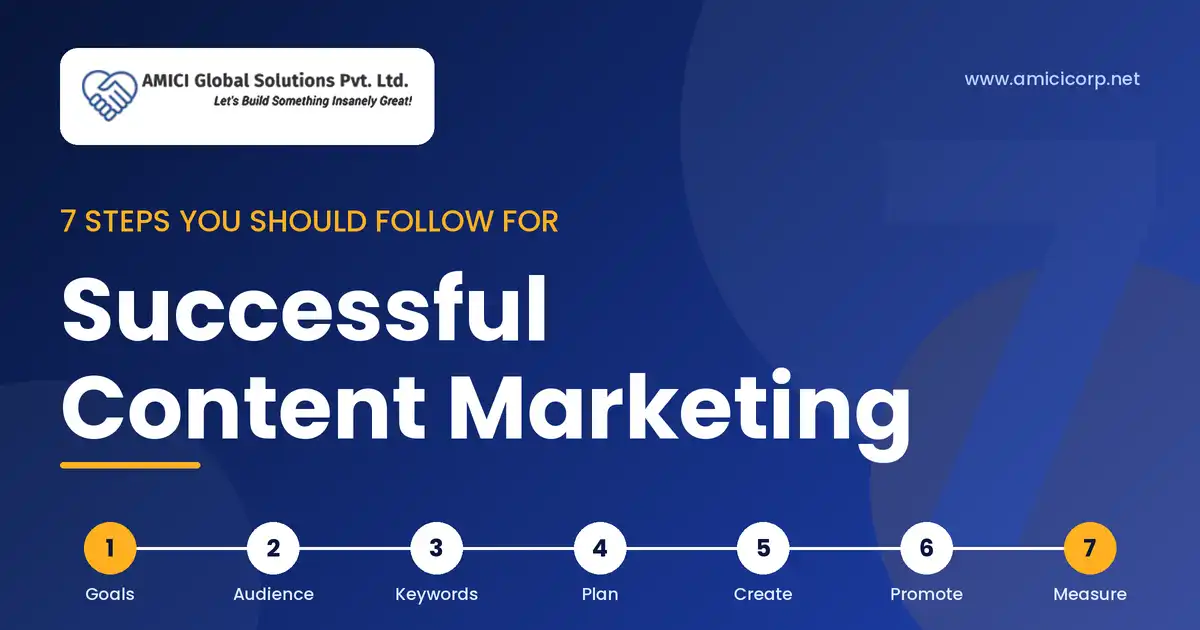
In this guide, you will learn the seven steps you should follow for successful content marketing. Whether you run a small local shop, a coaching institute, a real estate firm or a growing online brand, these steps will help you plan, create, publish, promote and measure content that brings organic traffic, builds trust and generates leads.
If you would rather have experts handle the process for you, the team at AMICI Global Solutions offers complete digital marketing services built around measurable business results.
What Is Content Marketing?
Content marketing is a strategic approach in which a business creates and shares valuable, relevant and consistent content to attract a clearly defined audience and encourage profitable action. That action may be a phone call, a form submission, a purchase, a subscription or simply a stronger brand relationship.
Unlike traditional advertising, which interrupts people, content marketing earns attention by being genuinely useful. A person searching for "how to improve my website ranking" does not want a sales pitch. They want a clear, trustworthy answer. When your business provides that answer, you gain credibility, and credibility leads to conversions.
Why Content Marketing Matters for Business Growth
Content marketing matters because buying behavior has changed. Customers research online before they contact a business. They read blogs, compare options, watch videos and check reviews. A business that appears at each of these moments has a strong advantage.
Here is what a well-planned content marketing strategy can do for you:
- Increase organic traffic from search engines without paying for every click
- Build brand authority and trust in your industry
- Generate qualified leads who already understand your service
- Support every other channel, including SEO, social media and email
- Lower long-term customer acquisition cost, because good content keeps working for months and years
Content Marketing vs Digital Marketing
Many people confuse the two terms. Digital marketing is the broad umbrella that covers SEO, paid ads, social media, email, web design and more. Content marketing is one important part of that umbrella, focused on creating and sharing valuable information. The two work best together, which is why most successful brands combine content with search engine optimization and social media optimization instead of treating them separately.
Step One: Define Clear Content Marketing Goals
Every successful content marketing plan begins with a clear destination. Without defined goals, you cannot decide what to create, where to publish or how to measure success.
Connect Content Goals to Business Goals
Start with what your business actually needs. Do you need more website visitors, more phone enquiries, more course enrollments, more store visits or better brand recognition? Your content goals should support these outcomes directly.
Common content marketing goals include:
- Brand awareness: Reaching new people who have never heard of you
- Lead generation: Collecting enquiries, calls and form submissions
- Customer education: Helping buyers understand a product or service before purchase
- Customer retention: Keeping existing customers engaged and loyal
- Thought leadership: Becoming the trusted voice in your niche
Use SMART Goals
A goal such as "get more traffic" is too vague. A SMART goal is specific, measurable, achievable, relevant and time-bound. For example, "increase organic blog traffic by forty percent and generate thirty qualified leads each month within six months" gives your team something concrete to work toward and track.
Choose the Right Key Performance Indicators
Each goal needs a matching metric. Awareness goals are measured through impressions, reach and organic sessions. Lead goals are measured through form fills, calls and conversion rate. Authority goals are measured through backlinks, brand searches and mentions. Decide these indicators now, so you are not guessing later.
Step Two: Understand Your Target Audience
Content that speaks to everyone connects with no one. The second step is to understand exactly who you are creating content for, what they struggle with and how they search for solutions.
Build Detailed Buyer Personas
A buyer persona is a semi-fictional profile of your ideal customer. It should include age range, profession, location, income level, challenges, goals, preferred platforms and common objections. A local retail owner in West Delhi, for instance, has very different needs from a university student searching for a digital marketing course.
Gather this information from real sources, including customer conversations, sales calls, support questions, reviews, social media comments and your website analytics. The more specific your persona, the easier it becomes to create content that feels personal.
Map Content to the Buyer Journey
People do not buy the moment they first discover you. They move through stages, and your content should support each one.
- Awareness stage: The person has a problem but may not know the solution. Educational blogs, beginner guides and short videos work well here.
- Consideration stage: The person is comparing options. Comparison articles, case studies, checklists and in-depth guides help them evaluate.
- Decision stage: The person is ready to choose. Testimonials, service pages, pricing explanations and free consultations move them forward.
A balanced content marketing funnel covers all three stages, so you never lose people halfway.
Understand Search Intent
Search intent is the reason behind a search. Informational intent means the person wants to learn. Navigational intent means they want a particular website. Commercial intent means they are comparing options. Transactional intent means they are ready to buy. Matching your content format to the intent behind each search is one of the strongest ranking and conversion factors available to you.
Step Three: Conduct Keyword and Topic Research
Once you know your audience, the next step is to discover what they are actually searching for. Keyword research turns audience guesswork into data.
Find High-Volume and High-Intent Keywords
Begin with broad topics related to your business, then expand them into specific search phrases. Look for terms with healthy search volume, reasonable competition and clear intent. Long-tail keywords, which are longer and more specific phrases, often convert better because the searcher knows exactly what they want.
For example, "content marketing" is a broad term with heavy competition. Phrases such as "content marketing strategy for small business", "how to create a content calendar" and "content marketing tips for beginners" are more specific, easier to rank for and closer to real needs.
Build Topic Clusters
Modern search engines reward depth and expertise. Instead of writing isolated posts, build topic clusters. A cluster has one comprehensive pillar page on a main topic, supported by several related articles that cover subtopics in detail and link back to the pillar. This structure shows search engines that your website is a complete resource on the subject.
A content marketing cluster might include articles on keyword research, blog writing, content distribution, email marketing, social media promotion, content analytics and content repurposing, all connected through internal links.
Study Competitors and Content Gaps
Review the pages that already rank for your target keywords. Note their structure, depth, format and what they miss. Your aim is not to copy them but to create something more complete, more accurate and more useful. Content gaps, meaning questions that competitors do not answer well, are your biggest opportunity.
A professional SEO company can speed up this research with advanced tools and local market insight.
Step Four: Plan Your Content Strategy and Calendar
With goals, audience and keywords ready, you now need a plan that organizes what to publish, when and where.
Choose the Right Content Formats
Different formats serve different purposes. Select the ones that fit your audience and your resources.
- Blog articles: The foundation of organic search traffic and informational content
- Videos and short reels: Ideal for engagement, product demonstrations and storytelling
- Infographics: Useful for explaining data and processes visually
- Case studies: Powerful proof for the decision stage
- Email newsletters: Strong for nurturing leads and retaining customers
- Podcasts and webinars: Effective for building authority and deeper trust
- Downloadable guides and checklists: Excellent for lead generation
You do not need to use every format. It is better to do two or three formats consistently and well than to spread yourself thin.
Create a Content Calendar
A content calendar is a simple schedule showing the topic, target keyword, format, author, publish date and promotion channel for each piece of content. It keeps your team organized, prevents last-minute stress and ensures steady publishing, which both audiences and search engines appreciate.
Plan around seasonal moments, festivals, industry events and product launches that matter to your customers. Leave some room for timely topics and trends as they appear.
Assign Roles and Workflow
Decide who researches, writes, edits, designs, publishes and promotes. Clear ownership avoids delays. If your internal team lacks time or skills, outsourcing to a professional content writing service can keep quality high and publishing consistent.
Step Five: Create High-Quality, Valuable Content
This is the heart of the process. Everything before this step prepares you to create content that genuinely helps your reader.
Focus on Quality, Accuracy and Originality
Search engines and readers both prefer content that demonstrates real experience, expertise, authoritativeness and trustworthiness. This is often described as E-E-A-T. To reflect it in your writing:
- Share first-hand experience, examples and practical lessons
- Support claims with reliable data and credible sources
- Keep information accurate, current and clearly explained
- Show who wrote the content and why they are qualified
- Avoid exaggeration, fluff and copied material
Write for Humans First, Then Optimize for Search
Write clearly, answer the main question early and use simple language. Then refine the content for search engines. Include the primary keyword naturally in the title, introduction, one or more headings and the meta description. Use related terms and synonyms where they fit. Never stuff keywords, because it harms readability and rankings.
Structure Content for Easy Reading
Most readers scan before they read. Make your content scannable by using:
- A strong, descriptive title that promises a clear benefit
- Short paragraphs of two to four lines
- Logical headings and subheadings
- Bullet lists and tables where helpful
- Relevant images, charts or videos with descriptive alt text
- A clear call to action at the end
Include Visual and Interactive Elements
Images, screenshots, short videos and simple graphics keep readers engaged longer and help explain complex ideas. A well-designed website also makes your content easier to consume. If your site is slow, outdated or hard to use on mobile, even excellent content will underperform. Investing in professional web design and reliable web development gives your content the strong foundation it deserves.
Add Clear Calls to Action
Every piece of content should guide readers toward a next step. That might be reading a related article, downloading a guide, subscribing to a newsletter or contacting your team. A helpful, relevant call to action turns readers into leads without feeling pushy.
Step Six: Distribute and Promote Your Content
Publishing is not the finish line. Even the best content needs help to reach its audience. Distribution is where many businesses fall short.
Use Owned, Earned and Paid Channels
Think of distribution in three groups:
- Owned channels: Your website, blog, email list and social profiles
- Earned channels: Backlinks, mentions, shares, guest posts and media coverage
- Paid channels: Social media ads, search ads and sponsored placements
A healthy strategy blends all three, relying most on owned and earned channels for long-term growth.
Promote Through Social Media
Share each piece on the platforms where your audience is active. Adapt the message to each platform instead of posting identical text everywhere. Break a long article into key points, quotes, carousel slides or short videos. A structured approach to social media optimization helps your content gain visibility, engagement and consistent brand recognition.
Leverage Email Marketing
Your email list is an asset you control. Send subscribers your best new content with a short, compelling summary. Segment your list by interest or buyer stage so each person receives the most relevant material.
Build Backlinks and Partnerships
Backlinks from trusted websites signal authority to search engines. Earn them by creating link-worthy resources, writing guest articles for reputable sites, sharing original research and building real relationships with other businesses and publishers.
Strengthen Internal Linking
Internal links connect your own pages, help readers discover more useful content and guide search engines through your website. Link new articles to related older ones, and link informational posts naturally to relevant service pages. For example, a post about attracting visitors can point readers to your blog library for deeper learning, and a post about expert help can lead them to your digital marketing service page.
Repurpose Content for Greater Reach
One strong article can become many assets. Turn a guide into a short video, an infographic, a social media series, an email sequence or a webinar outline. Repurposing saves time, reinforces your message and reaches people who prefer different formats.
Step Seven: Measure, Analyze and Improve
Content marketing is a continuous cycle. The final step is to review performance, learn from the results and improve the next round of content.
Track the Right Content Marketing Metrics
Use analytics tools to monitor metrics tied to your original goals. Important ones include:
- Organic traffic: Visitors arriving through search engines
- Keyword rankings: Positions for your target search terms
- Engagement: Time on page, scroll depth and pages per session
- Conversion rate: The percentage of visitors who take a desired action
- Lead quality: Whether the enquiries match your ideal customer
- Backlinks and referring domains: Signs of growing authority
- Return on investment: Revenue or value generated compared with cost
Run Regular Content Audits
A content audit reviews your existing pages to decide what to keep, update, merge or remove. Look for high-performing posts that can be expanded, older articles with outdated information, pages that compete for the same keyword and thin content that adds little value. Refreshing a good older post often brings faster results than writing a new one.
Test, Learn and Refine
Experiment with headlines, formats, publishing times, calls to action and content length. Keep what works and drop what does not. Over time, your data will show which topics your audience values most, so you can focus your effort where returns are highest.
Report Progress Clearly
Share simple monthly reports with your team or stakeholders. Show progress against goals, highlight wins, explain weak areas and outline next actions. Transparent reporting builds trust and keeps everyone aligned.
Common Content Marketing Mistakes to Avoid
Even with a strong process, certain errors can limit your results. Watch out for these:
- Publishing without a documented strategy or clear goals
- Ignoring search intent and writing what you want instead of what people need
- Focusing on quantity instead of quality
- Skipping promotion and expecting content to spread by itself
- Neglecting mobile experience and page speed
- Failing to update older content
- Measuring vanity metrics, such as likes, instead of leads and revenue
- Giving up too early, since content marketing often takes several months to show strong results
Essential Content Marketing Tools
The right tools make each step easier. Consider the following categories:
- Keyword research tools: To find search volume, difficulty and related terms
- Analytics platforms: To track traffic, behavior and conversions
- Content planning tools: To manage calendars, tasks and approvals
- SEO writing assistants: To check structure, readability and optimization
- Design tools: To create graphics, thumbnails and social visuals
- Email platforms: To send newsletters and automate sequences
- Social scheduling tools: To plan and publish posts across platforms
Tools support your strategy, but they cannot replace clear thinking, real expertise and consistent effort.
How Long Does Content Marketing Take to Work?
Content marketing is a long-term investment. Social media and paid promotion can bring quick visibility, but organic search growth usually takes around three to six months to build momentum, and sometimes longer in competitive industries. The reward is compounding growth. A well-optimized article can bring visitors and leads for years with only occasional updates, which makes content one of the most cost-effective channels over time.
Learn Content Marketing Skills Professionally
If you want to build these skills yourself, structured training can shorten your learning curve. A practical digital marketing course covers content strategy, SEO, social media, paid advertising and analytics with hands-on practice. It is a strong option for students, freelancers, business owners and professionals who want to grow their careers or their businesses.
Final Thoughts: Turn These Steps into Consistent Growth
Successful content marketing is not about luck, viral moments or publishing as much as possible. It is about following a smart, repeatable process: set clear goals, understand your audience, research the right keywords, plan carefully, create valuable content, distribute it widely and keep improving through data.
When you apply these seven steps consistently, your content becomes a reliable engine for traffic, trust and leads. Start with one goal, one audience and one well-researched topic, then build from there.
If you want an experienced partner to plan and manage your content, SEO and online growth, explore the full range of services from AMICI Global Solutions, learn more about our team, or get in touch for a free consultation.
Frequently Asked Questions About Content Marketing
Q: What are the main steps of a successful content marketing strategy?
A successful content marketing strategy follows a clear sequence. You define goals, understand your audience, research keywords and topics, plan a content calendar, create valuable content, distribute and promote it, and finally measure and improve the results. Skipping any of these stages usually weakens the overall outcome.
Q: What is content marketing in simple words?
Content marketing means creating and sharing useful information, such as blogs, videos, guides and social posts, to attract and help your ideal customers. Instead of pushing a sales message, you earn trust by solving problems, and that trust eventually leads to enquiries and sales.
Q: Why is content marketing important for small businesses?
Small businesses often have limited advertising budgets. Content marketing helps them compete by bringing in organic traffic, building credibility and generating leads at a lower long-term cost. A helpful blog or video can keep attracting customers long after it is published.
Q: How do I create a content marketing plan from scratch?
Begin by setting a measurable goal and defining your target audience. Next, research keywords and customer questions, choose suitable content formats and build a simple calendar. Then create, publish and promote your content, and review the results every month so you can adjust your plan.
Q: How often should I publish content?
Consistency matters more than frequency. For most businesses, one to two high-quality blog posts per week or a few well-planned posts per month is enough to begin with. Choose a schedule you can maintain without reducing quality, and increase it as your team grows.
Q: How long should a blog post be to rank on Google?
There is no fixed length that guarantees ranking. The best length is whatever fully answers the search query. Informational guides often perform well at around one thousand five hundred to two thousand five hundred words, but a shorter post can rank if it is clear, accurate and complete.
Q: How does SEO fit into content marketing?
SEO makes your content easier for search engines to find and understand, while content gives SEO something valuable to rank. Keyword research, search intent, on-page optimization, internal linking and backlinks all work together with your content to bring organic traffic.
Q: What types of content work best for generating leads?
Educational blog posts, in-depth guides, case studies, checklists, webinars and email newsletters are strong lead generators. The best choice depends on your audience and where they are in the buying journey, so it helps to use a mix of formats.
Q: How do I measure content marketing success?
Track metrics that match your goals. Common indicators include organic traffic, keyword rankings, engagement, conversion rate, lead quality, backlinks and return on investment. Reviewing these regularly shows what is working and what needs improvement.
Q: How long does it take to see results from content marketing?
Most businesses begin to see meaningful organic growth after three to six months of consistent, quality publishing. Results build over time as your content gains authority, rankings and backlinks, so patience and steady effort are important.
Q: Should I hire an agency or do content marketing in-house?
It depends on your time, skills and budget. An in-house approach gives you close control, while an agency brings experience, tools and a ready team. Many businesses choose a mix, handling simple tasks internally and using professionals for strategy, SEO and content creation.
Q: Can content marketing work for local businesses?
Yes. Local businesses can attract nearby customers by creating content around local searches, community topics and customer questions, and by optimizing their website and business profile for local results. This approach helps people in your area find and trust you before they visit or call.
Q: What is the difference between content marketing and copywriting?
Copywriting is persuasive writing designed to drive an immediate action, such as a purchase or a sign-up. Content marketing is a broader strategy that uses informative and engaging material to attract, educate and build relationships over time. Copywriting is often used within a content marketing plan.
Q: How can I improve old content that is not ranking?
Review the page for outdated facts, weak structure and missing search intent. Update the information, improve headings, add useful examples, strengthen internal links, refresh the title and meta description, and promote the updated page again. A thoughtful refresh often delivers quick improvements.